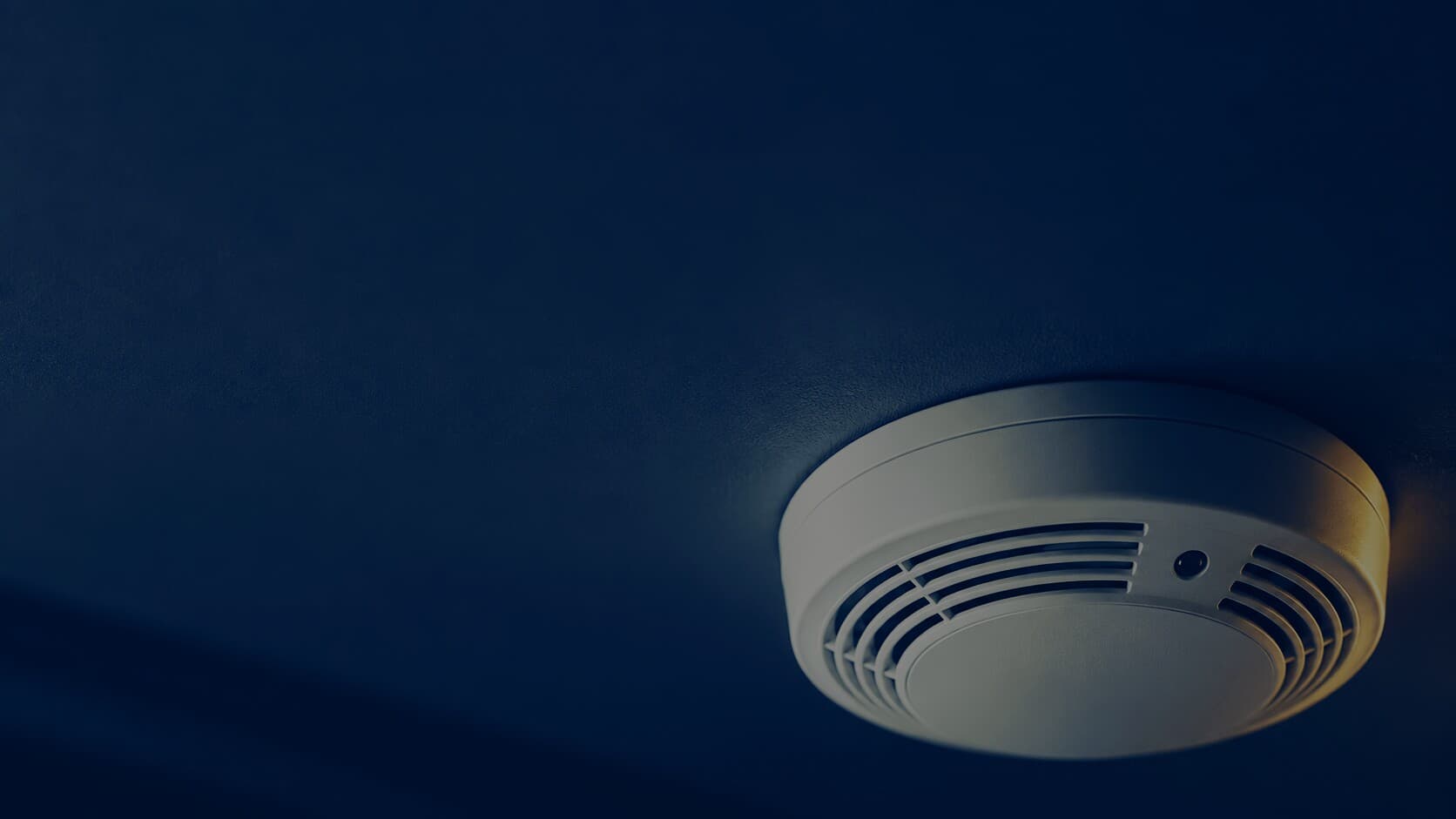
Smoke alarm installation
We check the alarms already on your ceilings, confirm what your home needs under Queensland’s rules, and fit and interconnect compliant photoelectric alarms, usually in a single visit.
What happens at the visit?
- Check. We look at what is already on your ceilings: whether each alarm is photoelectric, and whether its body carries the AS 3786-2014 marking.
- Confirm. We work out what the home needs. Alarms are required in each bedroom, on each storey, and in the hallways that connect bedrooms to the rest of the home.
- Fit and interconnect. We fit the alarms and link them, so that when any one detects smoke, every alarm in the home sounds.
- Test. We sound every alarm, and check the whole set together rather than one at a time.
- The paperwork. Hardwired interconnected smoke alarms need a Certificate of testing and compliance, issued under section 227 of the Electrical Safety Regulation 2013.
Hardwired or 10-year battery alarms?
Queensland’s rules decide this from what the home has now:
- A home with battery alarms can replace them with photoelectric alarms powered by a non-removable 10-year battery.
- A home with 240-volt (mains-powered) alarms must replace them with 240-volt photoelectric alarms.
- New homes and major renovations need hardwired 240-volt alarms.
- An alarm older than 10 years, or one that does not work when tested, must be replaced.
We confirm which applies once we have seen what is on your ceilings.
Does interconnecting the alarms mean new wiring?
Alarms can be interconnected by wiring them together, by wireless connection, or by a combination of both. Wireless interconnection is available for both 240-volt and battery alarms.
Can I keep my existing smoke alarms?
Only if every one of them meets all four requirements:
- Photoelectric, not ionisation. Required alarms must be photoelectric. An alarm containing an ionisation sensor does not comply.
- Interconnected across the dwelling. Every alarm must be interconnected with every other alarm in the home, so that when one activates they all activate.
- Marked AS 3786-2014. The alarm must comply with Australian Standard 3786-2014. The marking is on the body, you may need to lift it off the bracket to read it.
- Hardwired, or a sealed 10-year battery. Either hardwired to mains with a secondary power source, or powered by a non-removable 10-year battery.
An alarm older than 10 years, or one that does not work when tested, must be replaced.
The Queensland Fire Department says ionisation smoke alarms may not operate in time to warn you early enough to escape a smouldering fire, and that smouldering fires are the major cause of fatalities in house fires.
How many smoke alarms will my home need?
It depends on the number of bedrooms and storeys, and on how the hallways connect them. The calculator in our guide to Queensland smoke alarm laws gives an indicative count; we confirm on site.
Where do you install?
Across the Sunshine Coast and Noosa. See the suburbs we visit.
Sources
Every requirement on this page is taken from the official guidance below, checked on 15 September 2026. It is general information about the Queensland rules, not advice about your particular home.
- Queensland Fire Department, Smoke alarms, page updated 25 August 2026
- Queensland Fire Department, Frequently asked questions about smoke alarms, page updated 10 June 2026
Book an
assessment
Tell us the suburb and roughly what the dwelling is. We confirm what it needs and what the visit involves before anything is booked.
- Rather talk
- 0400 331 705
- Hours
- Mon–Fri 7am–5pm, Sat by arrangement